Online Slope Calculator
The PikaConverter Slope Calculator is a free online math tool for calculating the slope of a straight line between two points. Enter the x and y coordinates of two points to determine how steeply the line rises or falls.
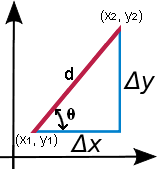
The calculator uses the standard slope formula, which divides the vertical change (rise) by the horizontal change (run). It also displays the mathematical formula for determining a line's inclination angle from its slope.
This online slope calculator is useful for students, teachers, engineers, and anyone working with coordinate geometry, linear equations, gradients, or mathematical measurements.
How to Use the Slope Calculator
Follow these steps to calculate the slope between two points using PikaConverter:
1. Enter the first point: Fill in the X₁ and Y₁ fields with the coordinates of the first point.
2. Enter the second point: Fill in the X₂ and Y₂ fields with the coordinates of the second point.
3. Calculate: Click the Calculate button.
4. Review the result: Check the calculated output using the displayed slope and inclination formulas.
For example, consider two points:
Point 1: (2, 3)
Point 2: (6, 11)
Enter:
· X₁ = 2
· Y₁ = 3
· X₂ = 6
· Y₂ = 11
The slope is:
m = (11 − 3) / (6 − 2)
m = 8 / 4
Result: m = 2
The line rises 2 units vertically for every 1 unit of horizontal movement to the right.
What Is the Slope of a Line?
The slope of a line measures how much its vertical coordinate changes relative to its horizontal coordinate.
In coordinate geometry, slope is commonly represented by the letter m.
A line with a positive slope rises from left to right, while a line with a negative slope falls from left to right.
A horizontal line has a slope of zero, and a vertical line has an undefined slope.
The slope of a straight line remains constant between any two distinct points on that line, provided the line is not vertical.
Rise Over Run
Slope is frequently described as rise over run.
· Rise (Δy): The difference between the y-coordinates.
· Run (Δx): The difference between the x-coordinates.
The basic relationship is:
Slope = Rise / Run
Or:
m = Δy / Δx
For example, if a line rises 6 units over a horizontal distance of 3 units:
m = 6 / 3
Slope = 2
The value indicates the change in y per unit change in x.
Slope Formula
The standard slope formula uses the coordinates of two points on a straight line.
m = (y₂ − y₁) / (x₂ − x₁)
Where:
· m is the slope.
· x₁, y₁ are the coordinates of the first point.
· x₂, y₂ are the coordinates of the second point.
· y₂ − y₁ is the vertical change.
· x₂ − x₁ is the horizontal change.
The formula is defined when:
x₂ ≠ x₁
If the x-coordinates are equal, the denominator is zero and the slope cannot be calculated as a finite number.
How to Calculate Slope Between Two Points
Consider the points:
(1, 2) and (5, 10)
Step 1: Identify the coordinates.
x₁ = 1, y₁ = 2
x₂ = 5, y₂ = 10
Step 2: Calculate the vertical change.
Δy = 10 − 2 = 8
Step 3: Calculate the horizontal change.
Δx = 5 − 1 = 4
Step 4: Divide rise by run.
m = 8 / 4
Result: m = 2
This means that y increases by 2 units for each unit increase in x.
Does the Order of the Points Matter?
No. Reversing the order of two distinct points does not change the calculated slope.
For example:
m = (10 − 2) / (5 − 1) = 8/4 = 2
Reversing the points gives:
m = (2 − 10) / (1 − 5) = −8/−4 = 2
The slope remains the same because both differences change sign.
However, you must subtract the coordinates in a consistent order. Mixing the x-coordinate order and y-coordinate order produces an incorrect result.
Positive and Negative Slope
The sign of the slope indicates the direction of a straight line as x increases.
Positive Slope
A positive slope means that the line rises from left to right.
For example, consider:
(1, 2) and (4, 8)
m = (8 − 2) / (4 − 1)
m = 6/3
Slope = 2
Because the slope is positive, the line increases as x increases.
Negative Slope
A negative slope means that the line falls from left to right.
For example:
(1, 8) and (4, 2)
m = (2 − 8) / (4 − 1)
m = −6/3
Slope = −2
The negative sign indicates a downward trend as x increases.
Zero Slope
A horizontal line has a slope of zero because its y-coordinate remains constant.
For example:
(2, 5) and (8, 5)
m = (5 − 5) / (8 − 2)
m = 0/6
Slope = 0
A zero slope does not mean the line has no length. It means the vertical coordinate does not change.
Undefined Slope
A vertical line has an undefined slope because its x-coordinate remains constant.
For example:
(3, 2) and (3, 9)
m = (9 − 2) / (3 − 3)
m = 7/0
Division by zero is undefined.
Therefore, the slope is undefined.
If both supplied points are identical, they do not determine a unique straight line, so a unique slope cannot be determined either.
Types of Slope
The following table summarizes the four common slope classifications.
Slope Type | Condition | Line Direction | Example |
Positive | m > 0 | Rises from left to right | m = 2 |
Negative | m < 0 | Falls from left to right | m = −2 |
Zero | m = 0 | Horizontal | m = 0 |
Undefined | Δx = 0 | Vertical, for distinct points | x = 3 |
Understanding these classifications helps you interpret line graphs and coordinate relationships.
Slope Percentage Calculator
Slope can also be expressed as a percentage, sometimes called percent slope or percentage grade.
This representation is common in construction, road design, land surveying, and measurements of ramps or terrain.
The slope percentage formula is:
Slope Percentage = (Rise / Run) × 100
When the slope m is already known:
Slope Percentage = m × 100
For example, a slope of 0.25 corresponds to:
0.25 × 100 = 25%
Result: 25% slope
This means that the vertical change is 25 units for every 100 units of horizontal distance.
How to Calculate Percent Slope
Suppose two points have the coordinates:
(0, 0) and (20, 3)
Calculate the slope:
m = (3 − 0) / (20 − 0)
m = 3/20
m = 0.15
Convert the result to a percentage:
Slope Percentage = 0.15 × 100
Result: 15%
A 15% uphill grade means 15 units of vertical rise for every 100 units of horizontal run.
The horizontal distance is used in this calculation, not the diagonal length along the sloped surface.
Slope Percentage Formula
Slope (m) | Slope Percentage |
−1 | −100% |
−0.5 | −50% |
−0.25 | −25% |
0 | 0% |
0.05 | 5% |
0.1 | 10% |
0.2 | 20% |
0.5 | 50% |
1 | 100% |
2 | 200% |
A slope percentage can exceed 100%. For example, a slope of 2 corresponds to a 200% grade.
A vertical line has an undefined slope and therefore no finite slope percentage.
Slope Angle Calculator
The slope angle describes the inclination of a line relative to the horizontal axis.
The relationship between slope and angle is based on the tangent function:
m = tan(θ)
To calculate the angle:
θ = arctan(m)
Where:
· θ is the inclination angle.
· m is the calculated slope.
· arctan is the inverse tangent function.
For a nonvertical line, this formula gives the signed angle between −90° and 90° relative to the positive horizontal direction.
How to Calculate the Slope Angle
Consider a line with slope:
m = 0.5
Apply the angle formula:
θ = arctan(0.5)
Result: θ ≈ 26.57°
Therefore, a line with a slope of 0.5 rises at approximately 26.57 degrees above the horizontal.
For a negative slope of −0.5:
θ = arctan(−0.5)
Result: θ ≈ −26.57°
The negative angle indicates a downward inclination relative to the positive x-direction.
Slope Percentage to Degrees
Slope percentages and slope angles are related, but they are not numerically equivalent.
To convert a slope percentage into an angle:
θ = arctan(Slope Percentage / 100)
For example, a 10% slope corresponds to:
θ = arctan(10/100)
θ = arctan(0.1)
Result: θ ≈ 5.71°
The following table provides common conversions.
Slope | Percentage | Angle |
0 | 0% | 0° |
0.05 | 5% | 2.86° |
0.1 | 10% | 5.71° |
0.125 | 12.5% | 7.13° |
0.25 | 25% | 14.04° |
0.5 | 50% | 26.57° |
1 | 100% | 45° |
2 | 200% | 63.43° |
Angle values are rounded to two decimal places.
A 100% slope corresponds to a 45° angle, not a vertical line.
Slope and the Equation of a Line
The slope is an important component of a linear equation.
A nonvertical straight line can be expressed in slope-intercept form:
y = mx + b
Where:
· m is the slope.
· b is the y-intercept.
· x and y are coordinates on the line.
The y-intercept is the point where the line crosses the y-axis.
Slope-Intercept Form
Consider the equation:
y = 3x + 2
Comparing it with y = mx + b:
m = 3
b = 2
Therefore, the line has a slope of 3 and a y-intercept of 2.
This means that y increases by 3 units whenever x increases by 1 unit.
Point-Slope Form
Another common way to describe a straight line is point-slope form:
y − y₁ = m(x − x₁)
This form uses a known point and the line's slope.
For example, suppose a line passes through (2, 3) with slope 4.
Substitute the values:
y − 3 = 4(x − 2)
Expand:
y − 3 = 4x − 8
Therefore:
y = 4x − 5
This is the corresponding slope-intercept equation.
Finding the Y-Intercept
If the slope and a point on the line are known, the y-intercept can be calculated as:
b = y₁ − mx₁
For example, suppose a line has slope 2 and passes through (3, 7).
b = 7 − 2(3)
b = 7 − 6
b = 1
The equation is:
y = 2x + 1
These are standard mathematical methods related to slope calculation, rather than separately confirmed output features of the PikaConverter tool.
Parallel and Perpendicular Lines
Slope is also used to identify relationships between straight lines.
Parallel Lines
Two distinct nonvertical lines are parallel when they have the same slope.
For example:
y = 2x + 1
y = 2x − 4
Both lines have slope 2.
Therefore, they are parallel.
Distinct vertical lines are also parallel, although their slopes are undefined.
Perpendicular Lines
Two nonvertical lines with finite, nonzero slopes are perpendicular when the product of their slopes equals −1.
m₁ × m₂ = −1
Equivalently:
m₂ = −1/m₁
For example, if one line has slope 2, a perpendicular line has slope:
−1/2
Horizontal and vertical lines are also perpendicular to one another.
Slope Calculation Examples
The following table shows examples of slope calculations using two points.
Point 1 | Point 2 | Slope | Classification |
(0, 0) | (4, 8) | 2 | Positive |
(1, 3) | (5, 7) | 1 | Positive |
(2, 8) | (6, 4) | −1 | Negative |
(1, 5) | (7, 5) | 0 | Zero |
(3, 2) | (3, 9) | Undefined | Vertical |
(−2, 1) | (2, 3) | 0.5 | Positive |
(−3, 4) | (1, −4) | −2 | Negative |
These examples demonstrate how the sign and magnitude of slope describe the direction and steepness of a line.
Applications of Slope Calculations
Slope calculations are used in mathematics, engineering, construction, surveying, and data analysis.
Coordinate Geometry
In coordinate geometry, slope describes the direction of a straight line between two points.
It is used to write linear equations, compare lines, and analyze relationships between coordinates.
Roads and Ramps
Road and ramp gradients are often expressed as percentages.
For example, if a ramp rises 1 meter over a horizontal distance of 10 meters:
Slope = 1/10 = 0.1
Slope Percentage = 10%
The corresponding angle is approximately:
θ = arctan(0.1) ≈ 5.71°
These calculations describe the ramp geometry. Whether a particular slope is acceptable depends on applicable design and accessibility standards.
Construction and Surveying
Engineers and surveyors use slope to describe terrain gradients, drainage paths, and changes in elevation.
For example, a drainage channel with a 2% slope has a vertical change of 2 cm per 100 cm of horizontal distance.
Mathematics and Graphing
Slope helps describe how straight-line graphs increase or decrease.
Students use slope when interpreting linear functions, graphing equations, and analyzing the relationship between variables.
Physics
The slope of a graph can represent a physical rate of change.
For example, the slope of a position-time graph represents velocity over a straight-line segment.
If position increases by 20 meters over 4 seconds:
Slope = 20/4
Velocity = 5 m/s
In this example, slope has units of meters per second because the vertical and horizontal axes represent different physical quantities.
Common Slope Calculation Mistakes
Several common errors can produce incorrect slope calculations.
· Reversing only one coordinate difference: Always subtract the x- and y-coordinates in the same point order.
· Confusing rise with run: Rise is the vertical difference, while run is the horizontal difference.
· Dividing by zero: A vertical line has an undefined slope.
· Assuming a negative slope means an invalid result: Negative slopes correctly describe lines that descend as x increases.
· Confusing zero slope with undefined slope: Horizontal lines have zero slope; vertical lines have undefined slope.
· Confusing slope percentage with angle: A 100% slope equals 45°, not 100°.
· Using the diagonal distance as run: Percentage grade uses horizontal distance.
· Mixing measurement units: When calculating a physical gradient, use consistent units for vertical and horizontal lengths.
· Assuming two identical points determine a unique line: One point alone does not identify a unique line.
· Assuming all slopes are unitless: Coordinate geometry slopes are dimensionless when both axes use the same units, but rates of change can carry units when the axes measure different quantities.
Frequently Asked Questions
What is a slope calculator?
A slope calculator is a mathematical tool that determines the slope of a straight line using two points. The standard formula is m = (y₂ − y₁)/(x₂ − x₁).
How do I calculate slope between two points?
Subtract the first y-coordinate from the second y-coordinate, then divide by the difference between the corresponding x-coordinates.
What is the slope formula?
The slope formula is:
m = (y₂ − y₁)/(x₂ − x₁)
It is also described as rise over run.
How do I use the PikaConverter Slope Calculator?
Enter X₁, Y₁, X₂, and Y₂, then click Calculate. The calculator uses the two-point slope formula.
What is rise over run?
Rise over run is the ratio of vertical change to horizontal change. It is another way of describing slope.
What is the slope between (1, 2) and (5, 10)?
The slope is:
m = (10 − 2)/(5 − 1) = 8/4 = 2
What does a positive slope mean?
A positive slope means that a line rises from left to right as x increases.
What does a negative slope mean?
A negative slope means that a line falls from left to right as x increases.
What is a zero slope?
A zero slope occurs when the y-coordinate remains constant. It represents a horizontal line.
What is an undefined slope?
An undefined slope occurs when the horizontal change is zero. For two distinct points, this represents a vertical line.
How do I calculate slope percentage?
Divide the vertical change by the horizontal change and multiply by 100.
Slope Percentage = (Rise/Run) × 100
How do I convert slope to percentage?
Multiply the numerical slope by 100. For example, a slope of 0.2 corresponds to 20%.
How do I convert slope percentage to degrees?
Divide the percentage by 100 and calculate the inverse tangent.
For example, a 25% slope corresponds to arctan(0.25), or approximately 14.04°.
What is a 100% slope in degrees?
A 100% slope corresponds to a 45° angle because the rise equals the horizontal run.
What is the slope of a 45-degree line?
The slope of a line inclined 45° above the horizontal is:
m = tan(45°) = 1
Can slope be greater than 1?
Yes. For example, a slope of 2 means the vertical change is twice the horizontal change, corresponding to a 200% grade.
Can slope be calculated with negative coordinates?
Yes. The slope formula works with positive, negative, and decimal coordinates as long as the horizontal difference is not zero.
Does swapping the two points change the slope?
No. Reversing the order of both points changes the signs of the numerator and denominator, leaving the slope unchanged.
How do I find the equation of a line using slope?
For a nonvertical line, use y = mx + b, where m is the slope and b is the y-intercept. If a point is known, calculate b = y − mx.
Is slope the same as gradient?
In coordinate geometry, slope and gradient are commonly used to describe the same rate of vertical change relative to horizontal change. In other contexts, the word gradient can have broader mathematical meanings.
Is the PikaConverter Slope Calculator free?
Yes. PikaConverter provides a free online tool for calculating the slope of a straight line from two coordinate points.